G-SPAN Ad Network
GreenPharms Self-Powered Adserver Network
First-party advertising infrastructure for centralized campaign delivery across owned digital properties, with scalable inventory control and proof of implementation already in place.

First-party
ad delivery
Campaign delivery lives on owned infrastructure instead of depending on third-party ad platforms.
Reusable
inventory layer
Campaigns and zones can scale across brands, pages, and future app surfaces.
Proof-backed
implementation
Screenshots document VM footprint, Revive setup, and owned-site placements.
Phase 1
readiness
Built for controlled rollout, validation, reporting, and later network expansion.
A working first-party ad layer with infrastructure evidence.
G-SPAN is presented with infrastructure captures, Revive adserver screens, and owned-site placement examples so ownership can evaluate both the concept and the work already completed.
Oracle Virtual Machine
Dedicated VM footprint for the ad stack, isolated from public sites.
Revive Adserver
Inventory, zones, and campaigns live here, with repeatable deployment rules.
Owned-site rendering proofs
Desktop captures showing ads rendered inside actual pages.
Across our owned digital properties, we already control the traffic, the context, and the audience. The missing piece has been a centralized way to scale advertising inventory across those surfaces without relying on third-party ad networks, opaque reporting, or recurring vendor fees.
G-SPAN establishes a single, first-party advertising layer that operates across owned domains, apps, and digital products, allowing campaigns to be deployed, managed, and measured from one system instead of handled piecemeal.
Control and resilience
Owned distribution that stays live when third-party enforcement swings overnight.
Reporting & Attribution
Clear performance visibility without black-box metrics.
One campaign, many surfaces
Publish creative once, then distribute across pages and brands with consistent rules.
Phased Deployment
Incremental implementation with minimal operational risk.
Why This Stays In-House
External ad-tech commonly introduces recurring costs, limited placement flexibility, and restrictions on how inventory can extend across websites and applications.
Running G-SPAN in-house preserves control over pricing, placement logic, data access, and scalability while reducing lock-in and avoiding unnecessary overhead.
What This System Does
The ad server functions as a shared advertising backbone across the ecosystem. Campaigns can be centrally managed and deployed across the network wherever placement rules allow.
This includes homepage placements, internal page placements, blog integrations, and app surfaces governed by one system rather than one-off implementations per site.
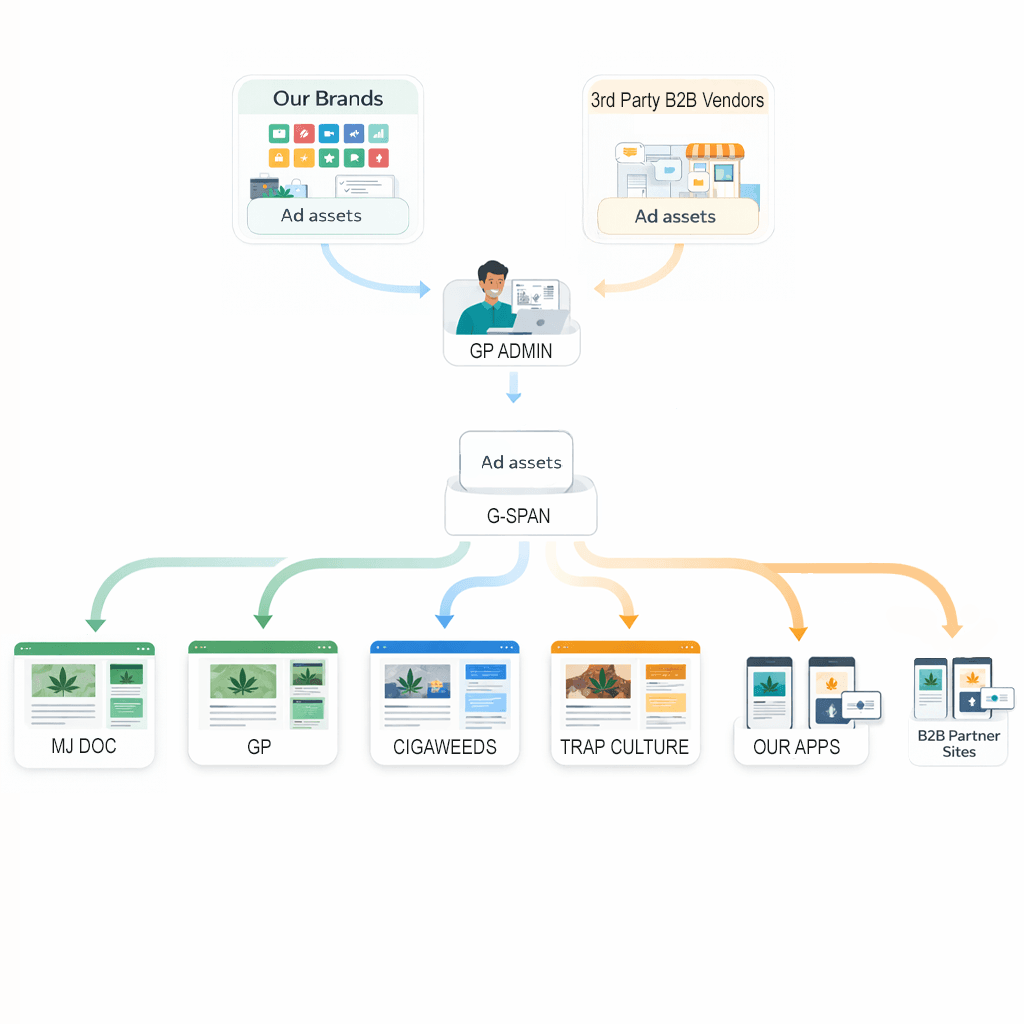
Concept: one GP admin layer controls campaigns, which flow through the ad server and render across defined zones.
How This Connects to Existing Revenue
This formalizes what already works. Existing on-site promo placements become reusable inventory that can be deployed consistently across brands and platforms.
The same system that supports internal promotions can support paid placements from partners using the same governance model.
Built to Scale With the Network
Because the ad server is not tied to a single site or brand, it scales alongside the digital footprint. New domains, apps, or surfaces can be integrated without rebuilding infrastructure.
The result is an internal advertising capability that increases leverage, reduces dependency on third parties, and creates a foundation for scalable monetization across owned digital surfaces.
Phase 1 Readiness
Phase 1 is positioned to validate performance across owned properties through controlled placements, stable reporting, and incremental rollout.